

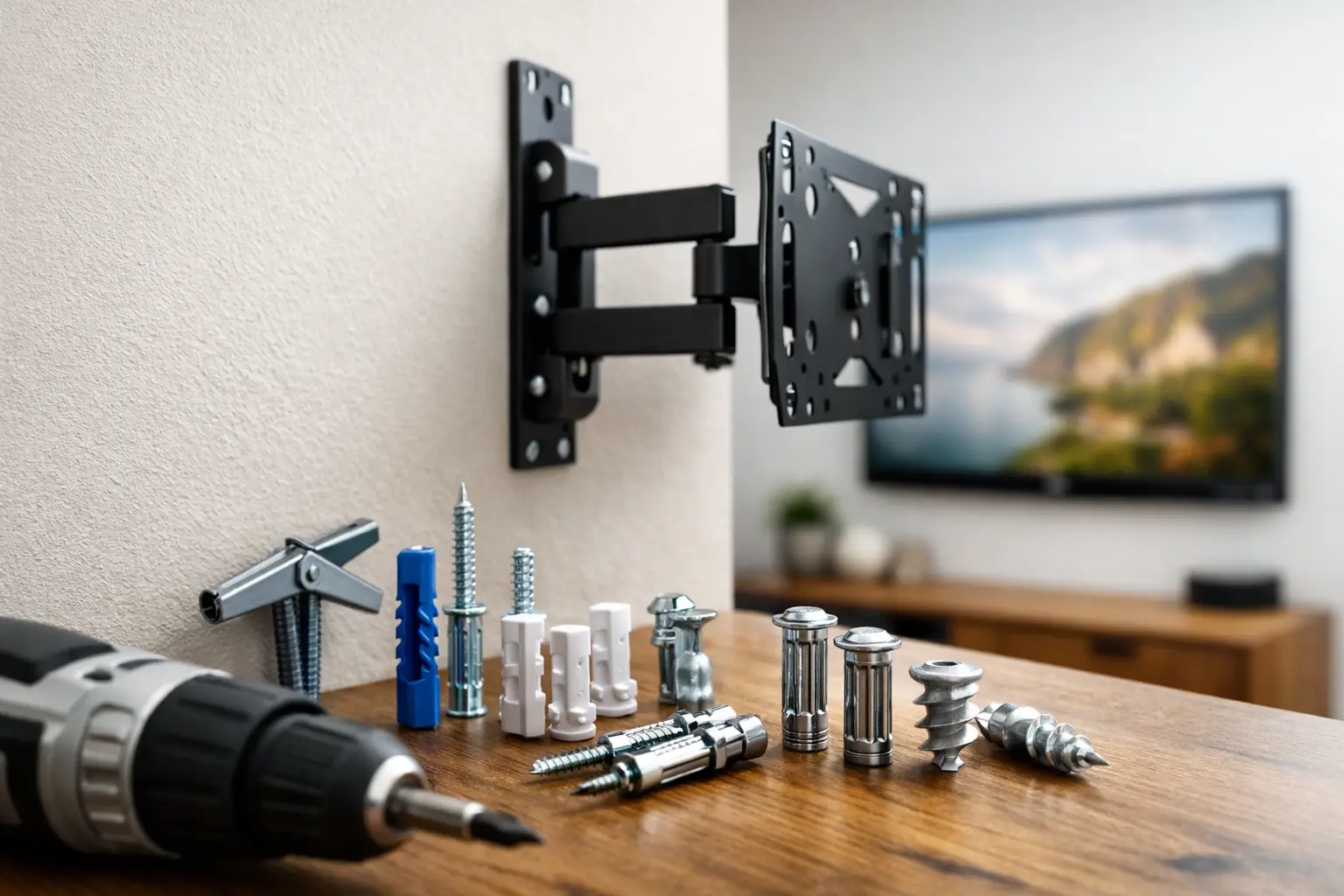
A TV that looks perfectly level can still be unsafe if the hardware behind the wall is wrong. The best anchors for TV mounting depend on your wall material, the size of the TV, the mount style, and whether the mounting plate can be secured to studs. Getting that decision right protects more than a screen – it protects your wall, furniture, and everyone in the room.
For most Austin-area homes, the safest answer is straightforward: fasten the TV mount directly into wall studs whenever possible. Anchors have a role, especially for drywall, masonry, and certain mounting situations, but they are not all designed to carry the shifting force created by a mounted television.
Start With the Wall, Not the TV
Before choosing an anchor, identify what is behind the mounting location. Drywall is only a finished surface. It is not the structural support that holds a heavy TV and a full-motion mount in place. Behind it, you may find wood studs, metal studs, concrete block, brick, or another material that requires a different fastening method.
A stud finder is useful, but it should not be the only check. Confirm the stud location with a small pilot hole in an area the mounting plate will cover, and check for electrical wiring or plumbing before drilling. In Central Texas homes, wall construction can vary widely by age, remodel history, and room. A wall that feels solid in one spot may have an unexpected cavity or metal framing a few inches away.
The TV mount manufacturer’s instructions matter just as much as the wall. Every mount has its own weight rating, fastener requirements, and approved installation methods. A strong anchor cannot make an incompatible mount safe.
Best Anchors for TV Mounting by Wall Type
Wood studs: Lag bolts are the preferred choice
For a TV mount installed on wood studs, use the lag bolts or structural screws supplied with the mount, provided they are in good condition and sized for the installation. These fasteners pass through the mounting plate and drywall, then bite into solid lumber behind the wall.
This is the most dependable method for fixed, tilting, and full-motion mounts. Full-motion arms are especially demanding because pulling the TV away from the wall creates leverage. Even a modest-sized TV can place much more stress on the fasteners when the arm is extended.
Ideally, the mounting plate spans two studs. Some mounts are designed for a single-stud installation, but the mount must specifically be rated for that use. Never assume one stud is enough simply because the plate has holes that line up with it.
Concrete, brick, and block: Use approved masonry anchors
For solid concrete or structural brick, masonry screws or expansion-style concrete anchors can provide a secure hold when correctly sized and installed. These anchors require precise drilling with the right masonry bit, a clean hole, and enough embedment depth to grip properly.
Brick and mortar are not equal. Fastening into sound brick is generally more reliable than drilling into weak or crumbling mortar. Hollow block and veneer brick can require specialized hardware, and the correct approach depends on the wall’s construction. If there is any uncertainty, this is a smart time to bring in an experienced installer rather than risking a cracked surface or failed mount.
Drywall with no studs: Heavy-duty toggle bolts are the only serious option
If a TV must be mounted where there are no accessible wood studs, heavy-duty metal toggle anchors are typically the strongest drywall option. Traditional spring toggles and strap-style toggles spread the load across the back of the drywall instead of relying on threads cut into gypsum.
That does not mean every toggle is appropriate for every TV. The anchor’s stated weight rating is only one part of the decision. TV mounts create both downward weight and outward pull. A full-motion mount multiplies that outward force, so drywall-only mounting is often a poor fit for articulating mounts, larger TVs, or homes with active children and pets.
When drywall-only mounting is permitted by the mount manufacturer, use all required anchor points, keep the mount flush to the wall, and do not substitute lightweight hardware. The condition of the drywall matters too. Old, water-damaged, patched, or cracked drywall should never be trusted to support a television.
Metal studs: Proceed carefully
Metal studs are common in apartments, condos, and newer construction. Unlike wood studs, thin-gauge steel studs may not safely hold a TV mount with standard lag bolts. Some mounting systems are approved for metal studs when paired with toggle-style fasteners that pass through the stud and drywall, while others require reinforcement or a different wall location.
This is not a situation for guesswork. The thickness of the stud, the TV weight, and the mount type all affect what is safe. If you are renting, also review your lease and get approval before making large wall penetrations.
Anchors to Avoid for TV Mounts
Small plastic expansion anchors, self-drilling drywall anchors, and basic picture-hanging hardware are not appropriate for most TV mounting jobs. They may work for a lightweight frame, a small shelf, or a cable cover, but a television is a dynamic load. It can be bumped, adjusted, pulled forward, or subjected to vibration over time.
Even anchors labeled with an impressive weight rating can be misleading when compared with a TV mount application. Those ratings may assume a static, vertical load in new drywall under ideal conditions. They do not automatically account for an arm mount extending 20 inches from the wall or a child accidentally grabbing the screen.
Avoid mixing random hardware from a toolbox with the hardware specified by the mount manufacturer. Using a bolt that is too short may not engage the stud enough. Using one that is too long can damage wiring, plumbing, or the wall cavity. The washer size, bolt diameter, and pilot-hole size all serve a purpose.
The Mount Style Changes the Hardware Decision
A low-profile fixed mount keeps the television close to the wall, which reduces leverage on the fasteners. A tilting mount adds some movement but remains relatively close to the wall. Full-motion mounts place the highest demand on the wall because the TV can extend, swivel, and shift its center of gravity.
For that reason, a drywall-only installation that might be acceptable for a small fixed TV may not be appropriate for the same TV on an articulating arm. Bigger screens are not the only concern. A compact TV on a long-arm mount can create more leverage than a larger screen on a fixed mount.
Consider the location as well. A TV above a fireplace may involve masonry, heat exposure, a high viewing angle, and limited stud access. A bedroom TV may be lighter, but it still needs a mounting method that can withstand everyday use. The right installation balances the room layout with the wall’s actual capacity.
A Safer TV Mounting Checklist
Before drilling, confirm the TV’s weight without its stand, the mount’s maximum capacity, and the wall type. Make sure the mount is rated for the TV’s VESA pattern, which is the spacing of the mounting holes on the back of the screen.
Then inspect the planned location for stud placement, outlets, cords, switches, and likely utility paths. Hold the wall plate in position, use a level, and mark every required fastening point. A mount can be level and still unsafe if only some of its fasteners are properly supported.
After installation, gently test the mount before hanging the TV. Once the TV is attached, verify that the safety locks are engaged and that cables have enough slack for any approved movement. Do not let power cords or HDMI cables pull against the TV when it swivels or tilts.
When Professional Installation Is Worth It
Mounting a TV becomes more complicated when studs do not line up with the ideal viewing location, the wall is brick or metal-framed, the screen is large, or the mount has an extending arm. The cost of a professional installation can be small compared with replacing a broken TV, repairing drywall, or dealing with an avoidable injury.
Smart Solutions TX provides secure TV mounting for homeowners and renters who want the job handled with care. Background-checked technicians can help assess the wall, install the right mounting hardware, level the screen, and leave your space ready to enjoy. It is a simple way to remove the uncertainty from a project that should feel stress-free.
A secure TV mount should disappear into the room – not become something you worry about every time the screen moves. Choose hardware based on the wall and mount, not the most convenient package on the shelf, and ask for help when the structure is unclear.